
Alexander County Court Docket Basics
A docket is the chronological record of what happens in a case. It may show a filing date, hearing date, event type, party activity, order entry, continuance, judgment, plea, or sentence. It does not always include the full text of pleadings, exhibits, recordings, or sealed attachments.
For Alexander County, docket access has two tracks. Public users can search many case and hearing details through the North Carolina eCourts Portal. When a docket line points to a document, certified copy, older file, or restricted item, the Alexander County Clerk of Superior Court remains the local custodian at the courthouse.
North Carolina court structure affects docket reading. District Court handles misdemeanors, infractions, traffic, juvenile, domestic, magistrate, and lower civil matters. Superior Court handles felonies, larger civil cases, and appeals from District Court. A docket entry should be read with that division in mind.
Find Alexander County Dockets Online
The Portal landing page exposes Smart Search for case information and Search Hearings for hearing dates. Search Hearings is the better starting point when the question is where and when to appear. Smart Search is better when the question is how the case has moved over time.
- Open the North Carolina eCourts Portal and allow JavaScript and cookies.
- Choose Search Hearings for court dates or Smart Search for case activity.
- Enter a name, case number, date range, or other live-app field available in the module.
- Filter to Alexander County when the statewide search allows county narrowing.
- Open the matching result and read the docket entries in date order.
- Call or visit the Clerk of Superior Court when a docket line refers to a document that is not available online.
Alexander County docket practice can also be shaped by the Alexander County local rules and forms page.
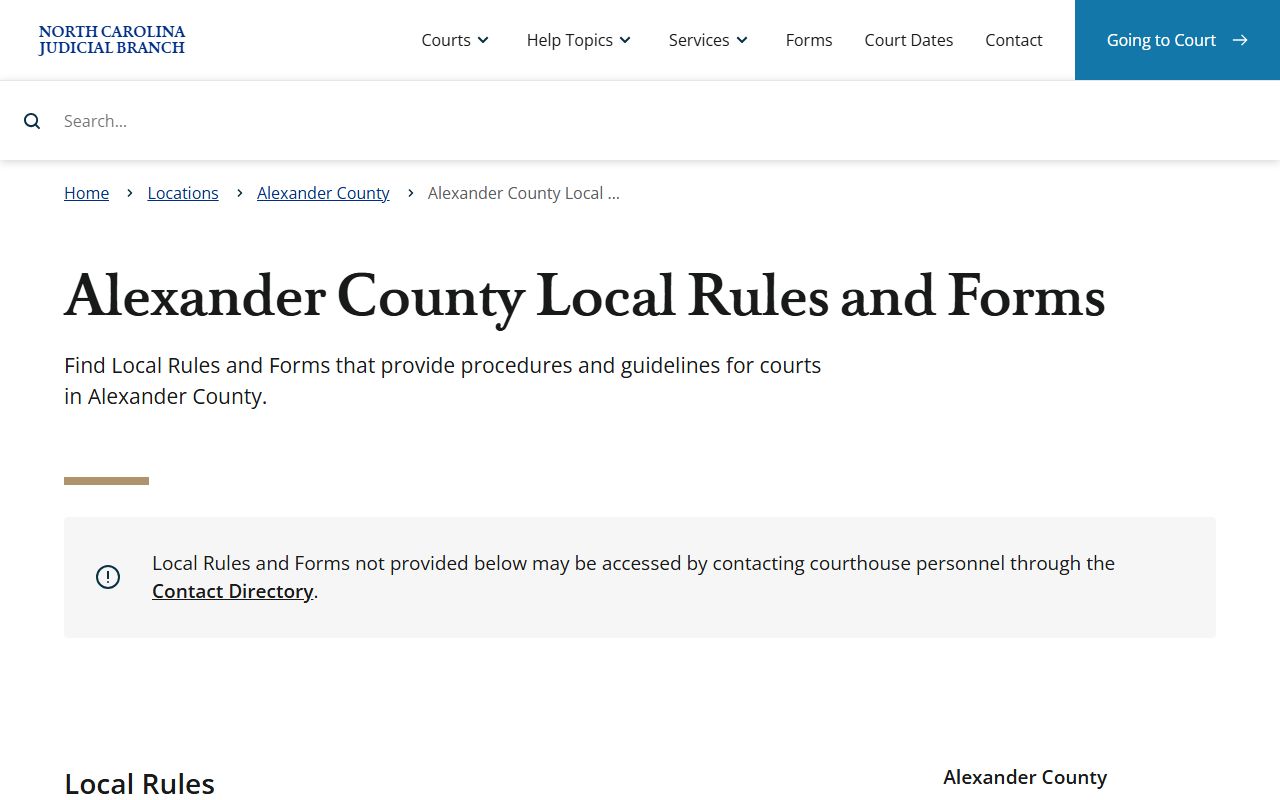
Local rules and forms matter because District 32 docket practice can be shaped by rules that apply to Alexander and Iredell counties.
Alexander County Docket Entry Fields
The research did not capture a full live case record without an interactive Portal session, but the court-record inventory gives the expected fields a user should look for. Hearing results and docket entries should be checked against the case number and party names before relying on them.
| Field | What It Shows |
|---|---|
| Case number | The court's identifier for the file and the safest value for clerk copy requests. |
| Case title or parties | The names tied to the action, such as State and defendant or plaintiff and defendant. |
| Court and county | Alexander County and the Superior or District Court division. |
| Event date | The date a filing, hearing, continuance, order, plea, judgment, or sentence was entered. |
| Hearing date | Date, time, court session, courtroom or location when available, and hearing type. |
| Docket text | A short description of the filing or action, often using court terms or abbreviations. |
| Disposition | The outcome of a charge, claim, motion, or case when final action has been entered. |
| Financial data | Costs, fines, restitution, payments, bonds, or civil judgment amounts when public and applicable. |
For cost and fee context tied to docketed judgments or payments, the Judicial Branch publishes current court costs.
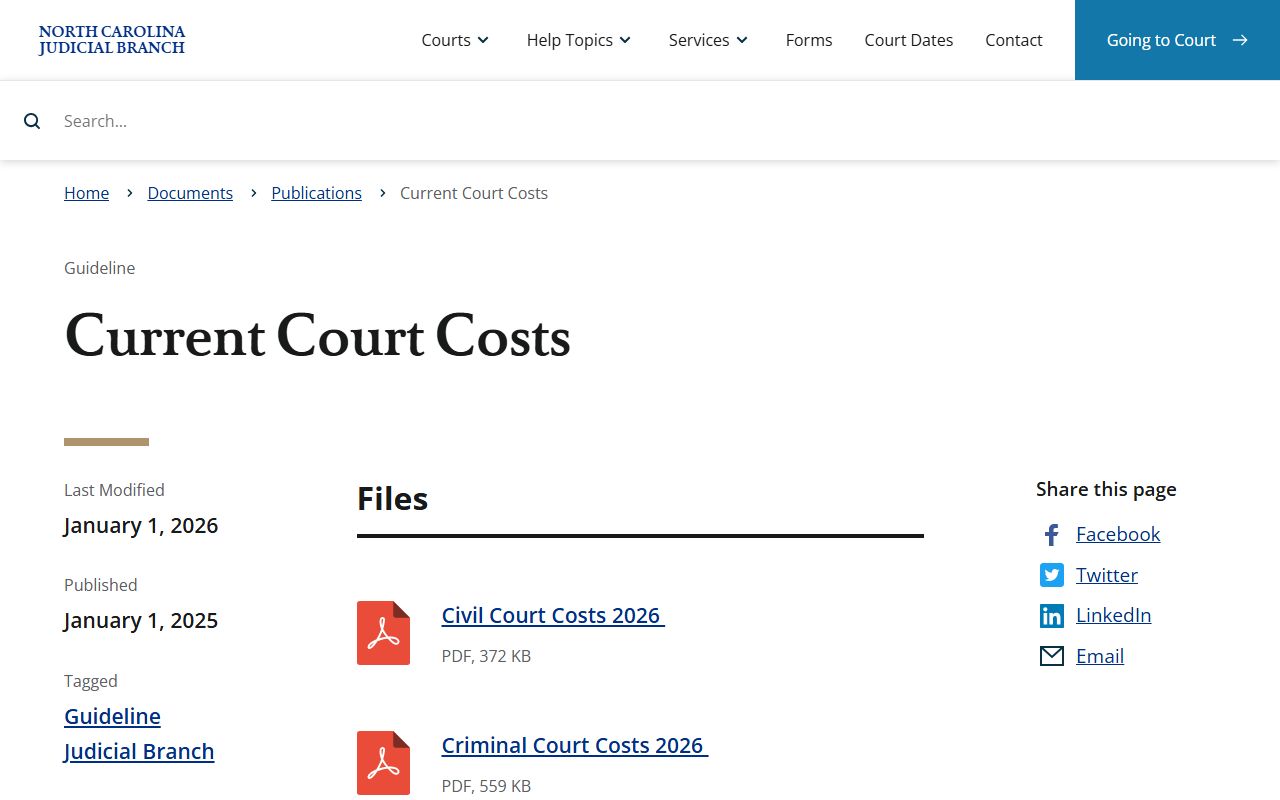
Court-cost publications help explain financial docket lines, but the clerk should confirm the amount due in a specific Alexander County case.
Courts With Alexander County Dockets
Alexander County docket information sits inside the North Carolina General Court of Justice. The county is listed in Prosecutorial District 32, Superior Court District 32, and District Court District 32. Several local rules and official contacts are shared with Iredell County, which is why careful county filtering matters.
| Court or Office | Docket Role | Local Contact |
|---|---|---|
| Superior Court | Felony criminal, civil cases involving $25,000 or more, and appeals from District Court. | Superior Court Judges: (704) 832-6616 |
| District Court | Misdemeanor, infraction, traffic, juvenile, domestic, magistrate, and lower civil matters. | District Court Judges: (704) 832-6612 |
| Magistrates | Initial appearances, warrants, small claims, and preliminary District Court duties. | Magistrates: (828) 635-3119 |
| Clerk of Superior Court | Trial court records, public terminals, file inspection, copies, payments, and probate filings. | Clerk: (828) 635-3113 |
| District Attorney | Criminal trial docket preparation and prosecution questions. | District Attorney: (704) 832-6610 |
The state court hierarchy appears on the Judicial Branch types of courts page.
That hierarchy explains why some Alexander County docket entries use Superior Court language while others use District Court or magistrate terms.
Docket vs Full Case Record
A docket is a tracking record. A full case record is the broader file. In Alexander County, the docket can tell a user that a motion was filed or an order was entered, but the actual motion or order may require clerk access, a copy request, or a courthouse visit.
| Docket | Full Case Record | |
|---|---|---|
| Format | List of events, dates, hearings, and outcomes. | Pleadings, orders, judgments, notices, and other file documents. |
| Best use | Track progress, confirm hearing dates, check disposition status. | Review the legal document, request certified copies, or verify complete filing history. |
| Access | Often visible through Portal or hearing search. | May require the clerk, public terminal, fee, certified copy request, or court permission. |
| Limits | Short entries can omit context or document text. | Confidential, sealed, juvenile, and redacted materials may still be restricted. |
Read Alexander County Court Dockets
Docket entries often use court terms. A motion is a request for a court order. A continuance is a reset. A disposition is the outcome of a charge or case. A judgment is the court decision or enforceable result. An arraignment is the proceeding where charges and plea are addressed.
Criminal docket entries should not be read as proof of guilt. A charge can be pending, dismissed, amended, reduced, or resolved by plea or trial. Civil docket entries can show claims and motions before the court has decided who is right. Traffic docket entries can show responsibility, dismissal, reduction, failure to appear, or payment status.
- Docket
- A chronological list of filings, hearings, orders, and case events.
- Disposition
- The outcome of a charge, claim, motion, or case.
- Continuance
- A hearing or trial moved to a later date.
- Judgment
- A final or enforceable court decision affecting rights, penalties, or money owed.
Note: Always confirm a near-term hearing with Portal or the clerk because court calendars can change after an online search.
Alexander County Calendar Rules
Local rules can affect when a case appears on a calendar, how continuance requests are handled, and which forms a party must use before a hearing. The Alexander County local rules page includes District 32 materials for civil superior court practice, District Court continuance policy, District Civil Court rules, juvenile court rules, calendar notice forms, discovery orders, financial affidavits, and domestic forms such as equitable distribution inventories and mediation orders.
Some local-rule document names still refer to older District 22 or 22A labels even though current Judicial Branch pages list Alexander County in District 32. That does not make the form useless by itself. It means docket users should check the current Judicial Branch page, the form title, and the clerk's instructions before assuming an older district label is stale.
| Local item | Why it matters for dockets |
|---|---|
| Continuance policy | Controls how a party asks to move a court date. |
| Calendar notice | Can place or confirm a matter on a civil or domestic calendar. |
| Juvenile local rules | Shape restricted juvenile proceedings shared by Alexander and Iredell counties. |
| District civil rules | Guide civil docket practice in District Court matters. |
| Mediation and parenting orders | Can create docket events in domestic cases before final hearing. |
Restricted Alexander County Dockets
A docket entry can be public while the underlying document is restricted, and some case types may have limited public visibility from the start. Juvenile delinquency, undisciplined cases, abuse, neglect, dependency matters, adoptions, sealed files, expunged records, protected addresses, confidential hearing recordings, and medical or financial details may be withheld or redacted.
For Alexander County court docket users, this means a missing result is not always a search mistake. The case may be confidential, sealed, expunged, too old for ordinary online display, or available only by asking the clerk under the correct rule. The clerk can identify the public access route, but cannot give legal advice about whether a party should ask a judge to open or release a restricted item.
Alexander County Docket Access Channels
Docket access is not limited to one database. The online channel is the fastest first check, but public self-service terminals and the clerk's office are still important for case-file review. For criminal background checks, the Judicial Branch specifically points users to county clerk offices rather than relying only on Portal.
- Online case and hearing search: use the eCourts Portal and select Alexander County when available.
- Public terminal: inspect available court information in the clerk's office at the courthouse.
- In person: visit the Alexander County Clerk of Superior Court for files, copies, and certified copies.
- By phone: use (828) 635-3113 for clerk and courthouse routing.
- Public-record request: use the Judicial Branch request form only for existing Judicial Branch records not handled through normal case-file access.
- Mail: contact the clerk first for copy fees and identifying case information before mailing a request.