
Alexander County Clerk Contact
North Carolina has a unified Clerk of Superior Court structure. Alexander County does not have separate county and district clerks for court records. The elected Clerk of Superior Court performs clerical and record-keeping functions for both Superior Court and District Court. The Judicial Branch says clerks keep court records under rules established by the N.C. Administrative Office of the Courts, collect money due to the State or parties, and serve as judge of probate for wills, estates, guardianships, partitions, adoptions, and other special proceedings.
The official Alexander County court contact directory lists the Clerk of Superior Court phone as (828) 635-3113. The courthouse page gives the court address as 29 W. Main Ave., Taylorsville, NC 28681, with mailing address PO Box 100, Taylorsville, NC 28681. The research notes a county elected-officials list naming Edwin P. Chapman as Clerk of Superior Court, term ending 2026, but the Judicial Branch directory should be checked for the current office listing before relying on a named official.
Alexander County Clerk of Superior Court
29 W. Main Ave.
Taylorsville, NC 28681
Mailing: PO Box 100, Taylorsville, NC 28681
(828) 635-3113
Monday-Friday, 8:00 a.m.-5:00 p.m.
Alexander County Clerk Duties
The Clerk of Superior Court is the correct office for court case files, court copy requests, certified court documents, public self-service terminals, estate filings, special proceedings, divorce judgments, judgments, and many court payments. In criminal matters, clerks also have duties tied to warrants, initial appearances, and minor pleas or waivers where state law and court rules allow. The clerk does not act as a legal adviser, so procedural and legal strategy questions should go to an attorney or the proper court form instructions.
- Maintain Superior Court and District Court records for Alexander County.
- Provide public file access, copies, and certified court copies for a fee.
- Collect court costs, fines, civil judgments, and other money due through court cases.
- Serve as probate judge for estate and special proceeding matters.
- Support public terminals and in-person records access at the courthouse.
- Route older, restricted, incomplete, or certified-copy requests that are not fully handled online.
The Judicial Branch court officials page explains clerk duties across North Carolina. Those statewide duties apply locally because Alexander County uses the unified North Carolina court system.
Request Alexander County Clerk Records
Most individual record searches should start with the North Carolina eCourts Portal and then move to the clerk if the online record is incomplete or a certified copy is needed. Alexander County joined the statewide eCourts system on October 13, 2025, so older online-access statements may be stale. Portal can provide Smart Search, hearing search, payments, and judgment search, but it is not the same as the complete physical or electronic case file maintained by the clerk.
| Access channel | Use it for | Alexander County notes |
|---|---|---|
| Online Portal | Case information, hearings, payments, judgments | Use Alexander County when county filtering is available. |
| In person | File review, public terminals, certified copies, older files | Visit the Clerk of Superior Court at the courthouse. |
| Payments or copy requests after confirming details | Mail payments to PO Box 100 with the proper certified funds. | |
| Public-record request | Existing Judicial Branch records not handled by ordinary case access | Use the Judicial Branch request form when the clerk help topic does not fit. |
| Remote Public Access | Licensed statewide data extracts and real-time access | Not the ordinary channel for one certified copy. |
Certified Alexander County Clerk Copies
A certified copy is a court copy that includes official certification from the clerk. It may be needed for appeals, agency filings, licensing, insurance, employment records, name-change proof, divorce judgment proof, or other legal use. A printed portal screen is not the same as a certified court copy. For certified copies, identify the case and document as closely as possible before contacting the clerk.
- Search Portal or your papers for the case number, party names, filing year, and case type.
- Identify the exact document needed, such as judgment, order, divorce judgment, letters, or docket entry.
- Contact or visit the Clerk of Superior Court to confirm copy fees and whether the document is public.
- Submit the request with enough identifying information and the required payment method.
- Ask whether pickup, mail, or another clerk-approved delivery method is available.
Note: Background checks should not rely on Portal alone because the Judicial Branch advises using the county clerk's office for that purpose.
Alexander County Request Fields
The research did not locate a separate Alexander County clerk copy-request form. The needed request fields come from the court-record workflow and the Judicial Branch public-record request routing. Include enough information for the clerk to locate the file without asking the office to create a new record or research a legal issue.
| Field | Required or useful | Notes |
|---|---|---|
| Case number | Useful | Best identifier when known from Portal, papers, or prior notices. |
| Party names | Yes | Use full names and roles if known. |
| Case type | Useful | Civil, criminal, traffic, estate, special proceeding, domestic, or judgment. |
| Document type | Yes | Judgment, order, divorce decree, letters, file copy, or other named document. |
| Filing year or date range | Useful | Helps distinguish people with similar names. |
| Certified or plain copy | Yes | Certification affects fees and use. |
| Requester contact | Yes | Include phone, mailing address, and any clerk-approved return method. |
Alexander County Clerk Fees
Clerk fees come from North Carolina court-cost rules and current cost schedules. The Alexander County payment page adds local payment instructions. Mail payments to court must be by money order or certified check, with no cash and no personal checks. In-person payments can include cash, credit or debit card with processing fees, money order, or certified check, but no personal checks. Online eligible payments use credit or debit card, and the Portal notice lists Visa, MasterCard, and Discover while excluding digital wallets such as Apple Pay, Google Pay, Cash App, and Venmo.
| Item | Official amount or rule |
|---|---|
| Court record photocopies | Per-page fee under current miscellaneous court-cost schedule |
| Certified court copies | Charged as prescribed by law; confirm current fee with clerk or cost schedule |
| Mail payment to court | Money order or certified check only; no cash and no personal checks |
| In-person payment | Cash, credit/debit plus processing fees, money order, or certified check; no personal checks |
| Online payment | Credit/debit plus processing fees if eligible; Visa, MasterCard, Discover accepted |
Clerk vs Register of Deeds
The Clerk of Superior Court and Register of Deeds are often confused because both offices issue official records. In Alexander County, the split is practical and important. Court case files, criminal cases, civil actions, estates, special proceedings, divorce judgments, judgments, traffic and infraction records, and certified court copies route through the Clerk of Superior Court. Marriage licenses, marriage certificates, birth and death records, delayed births, real estate instruments, military discharges, notary public commissions, and many genealogy records route through the Register of Deeds.
| Record need | Correct office | Reason |
|---|---|---|
| Divorce judgment | Clerk of Superior Court | It is a court record from a domestic civil case. |
| Marriage certificate | Register of Deeds | It is a vital record, not a court file. |
| Estate file | Clerk of Superior Court | The clerk acts as probate judge. |
| Real estate deed | Register of Deeds | Real property instruments are recorded outside the court case system. |
| Traffic case disposition | Clerk of Superior Court | Traffic and infraction cases are District Court records. |
The Register of Deeds fee source is useful for vital records, not court copy fees.
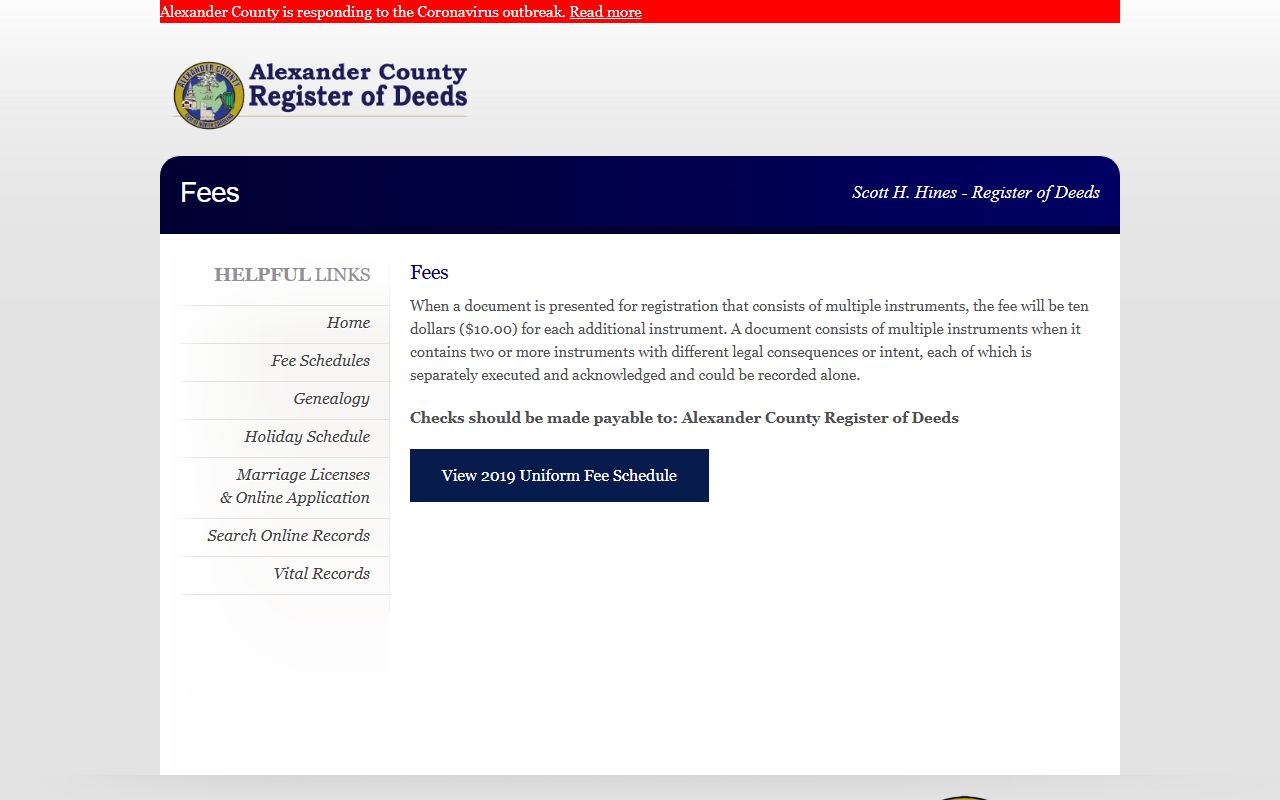
That fee page helps separate Register of Deeds copy costs from Clerk of Superior Court copy costs.
Alexander County Clerk Forms
Alexander County's local rules and forms page includes District 32 and older District 22 or 22A materials. Older titles may still use the prior district labels even though current Judicial Branch pages list Alexander County in District 32. Forms and local rules include civil superior court rules, pretrial release policy, district court continuance policy, juvenile rules for Iredell and Alexander Counties, equitable distribution forms, calendar notice forms, mediation orders, and other local materials.
The REAL ID vital-record notice is a good reminder that the Register of Deeds can issue only records it actually holds.
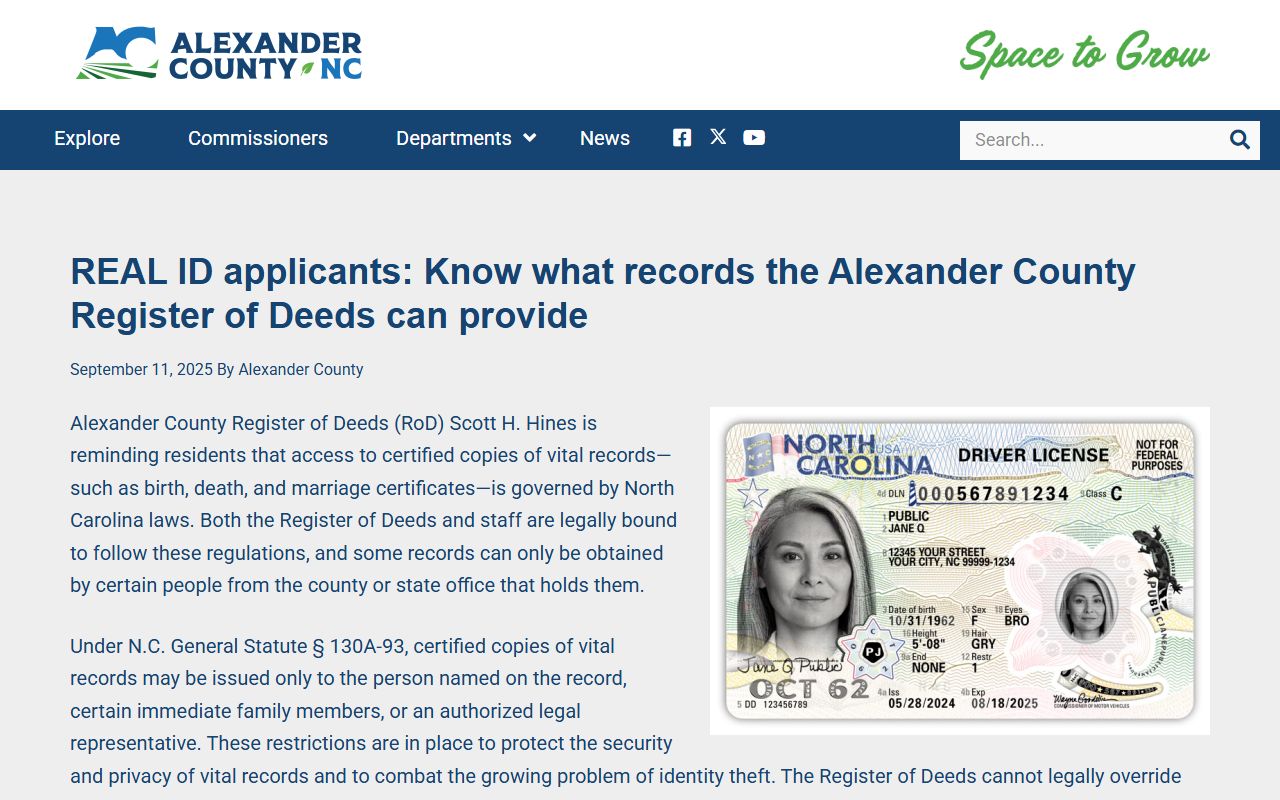
For court records, use the clerk and Judicial Branch forms; for vital proof, use the correct Register of Deeds or state vital-record source.
Alexander County Record Routing
Alexander County's 2025 Register of Deeds review gives local context for why residents sometimes need neighboring counties or state offices for birth records. The Register of Deeds noted that many Alexander County females give birth in hospitals in neighboring counties such as Catawba, Iredell, Wilkes, and Caldwell, and the office recorded only three births in 2025. That local fact does not change court record routing, but it helps explain why the right office depends on the record type and where the event was recorded.
The county's Register of Deeds year-in-review gives this local vital-record context.
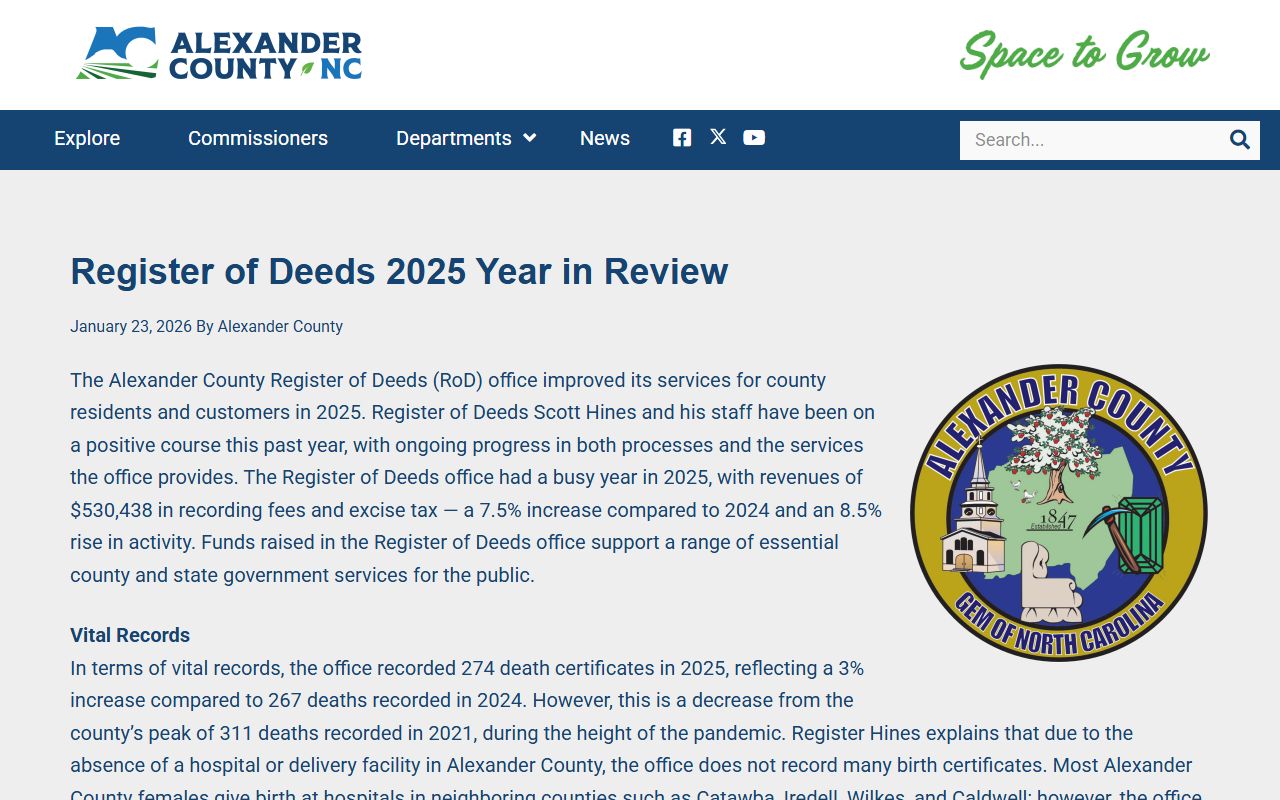
The same office split applies across the site: court records go to the clerk, while vital and land records go to the Register of Deeds.